
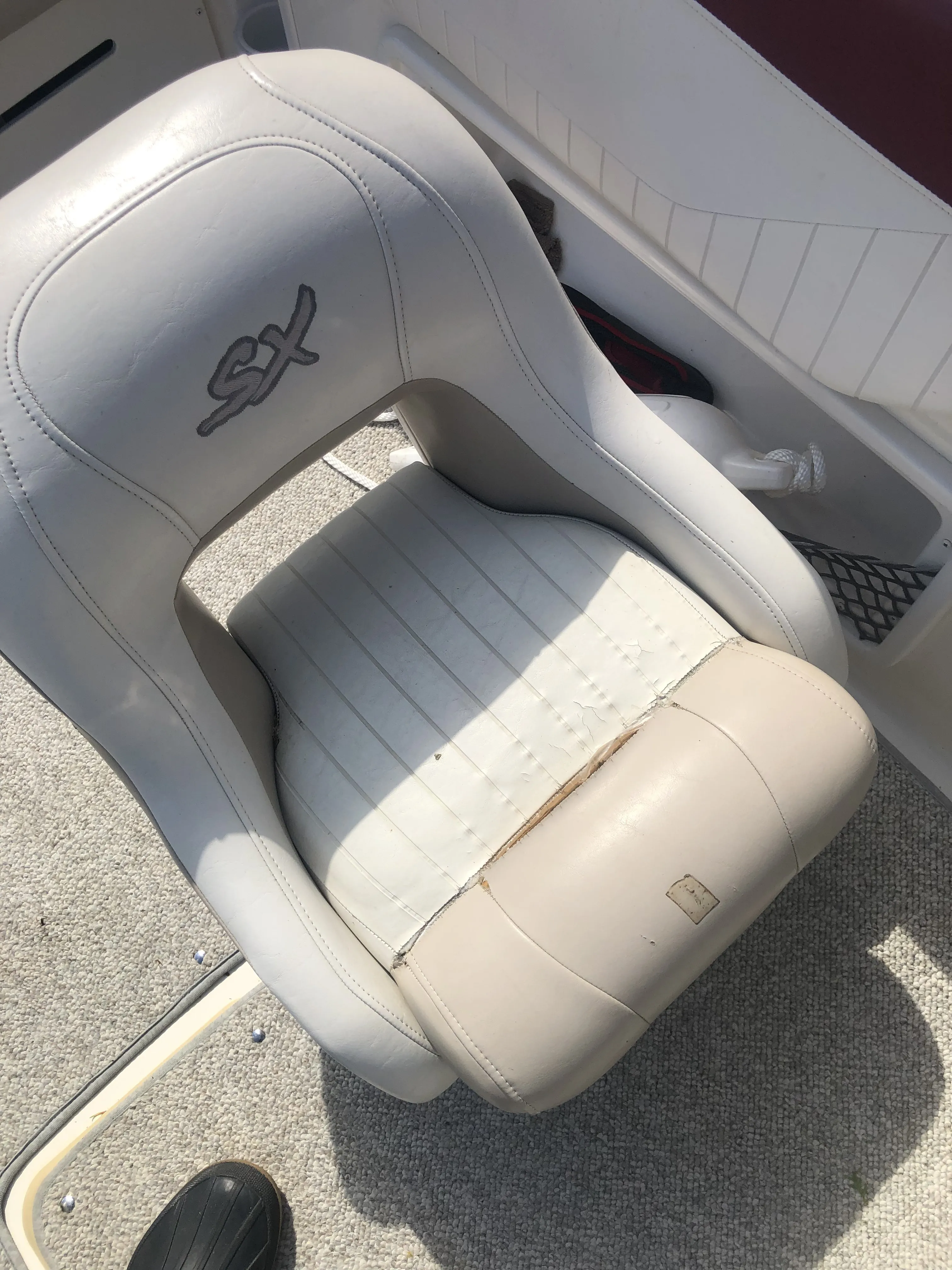
Leather is a wonderful material in a car interior. On a boat it is a maintenance problem: standing water, UV and salt will dry it out and crack it inside a season or two. This is the single most common mistake we see on boats that come in for reupholstery — a beautiful automotive material specified for an environment that will destroy it.
What makes a vinyl marine grade
Marine vinyl is not simply thicker upholstery vinyl. The differences that matter are in what has been engineered into it:
- UV stabilisation — so it does not go chalky and stiff in a season of full sun
- Mildew resistance — the backing and topcoat are treated, because marine upholstery spends its life damp
- Cold-crack resistance — it stays flexible through winter storage instead of splitting at the folds
- Rot-proof thread — a perfect cover stitched with the wrong thread fails at the seams first
That last point gets overlooked constantly. Thread is cheap and invisible, so it is the easiest place for a shop to save money — and it is the first thing to let go.
The foam matters as much as the cover
If your boat cushions stay damp, the cover is usually not the culprit. Standard upholstery foam is a sponge: it holds water against the cushion and against the deck, which is how you end up with mildew and a smell that never fully leaves.
Quick-dry reticulated foam has an open cell structure that lets water pass straight through instead of trapping it. It is more expensive per cushion and it is almost always the right call — it is the difference between a cushion that dries in an afternoon and one that never really does.
Canvas follows the same logic
Solution-dyed acrylic holds colour in full sun far longer than cheaper coated fabrics, because the colour goes through the fibre rather than sitting on top of it. The difference does not show in year one. It shows in year three, when the coated fabric has gone chalky and faded and the acrylic still looks like itself.
There are four families of marine top fabric in common use, and they genuinely suit different jobs:
| Fabric | Type | Strengths | Watch for |
|---|---|---|---|
| Sunbrella | Solution-dyed acrylic | Best-in-class UV and colourfastness, breathable, carries a 10-year warranty against fading | Water-resistant rather than fully waterproof — it relies on good design and upkeep |
| Top Gun | Coated polyester | Excellent abrasion resistance and strength, lower cost | Shorter service life in punishing sun; coating quality varies a lot by grade |
| Stamoid | Vinyl-coated | Maximum waterproofing of the four | Does not breathe, so trapped moisture underneath becomes the problem instead |
| Seamark | Sunbrella with a vinyl backing | Fully waterproof while matching Sunbrella colours — a common OE bimini and camper-top choice | Costs more than either parent material |
Notice the trade running through that table: waterproof and breathable pull against each other. Anyone who tells you one fabric wins on both is selling you something. The right choice depends on whether the boat lives on a lift, on a trailer, or in a slip.
Recover or replace?
Not everything needs replacing. A single split seam can often be restitched, and a cover in good condition over dead foam only needs the foam changed. Chalking on canvas, though, usually means a cheaper coated fabric has reached the end of its life, and no amount of cleaning brings it back.
Bring one cushion or one piece of canvas by the shop — you do not need to bring the whole boat — and we will tell you honestly which one you are looking at. More on our marine upholstery page.